

2026 Classical Buddhist Chinese Language Summer Workshop
Welcome
We are delighted to welcome you to DILA’s 2026 Classical Buddhist Chinese Language Summer Workshop — a community of scholars brought together by a shared passion for the Buddhist literary tradition.
The Dharma Drum Institute of Liberal Arts (DILA) is pleased to announce its 2026 Intensive Summer Program in Classical Buddhist Chinese. This three-week program is designed for scholars, researchers and graduate students who wish to deepen their proficiency in reading and translating classical Buddhist texts under the guidance of leading scholars.
Readings cover selections of Bodhisattva and Mahāyāna literature in classical Chinese translation, as well as texts related to the Vinaya and monasticism in East Asia.
The program combines close reading with philological methodology, providing graduate students with practical skills for dissertation research in Buddhist Studies, East Asian religions, and premodern Chinese intellectual history.

Orientation Guide
Before You Arrive — Please Read
- Sunday (July 26) — No meal service on campus. Please eat before you come up the mountain, or plan to bring vegetarian food. 週日(7/26)校內完全無供餐,請在山下用餐或攜帶素食上山。
- Saturday (July 25) early arrivals — Xin An Xuan (心安軒) cafeteria is open 17:00–18:00 for dinner ordering. 週六(7/25)提早抵校者,心安軒17:00–18:00開放點餐。
- Only vending machines on campus after hours. Stock up in Jinshan town before coming up, or arrive with a full stomach. 校內僅有自動販賣機,請提前於山下購買或吃飽再上山。
- Vegetarian campus — no meat products. Please do not bring any meat, fish, or seafood onto campus, including snacks. 素食校園:請勿攜帶任何肉類、魚類、海鮮製品入校(含零食)。
- Bring your passport. Room card and student ID will be issued at check-in — you will need the room card to enter the dormitory and the student ID to enter/exit campus. 請攜帶護照。房卡與學員證於報到時領取——房卡進出宿舍必備,學員證進出校園必備。
1 · Arrival Day (Sun, July 26) 報到日
Some of you have already been in touch with us about your arrival times so we can meet you at the dormitory for check-in — thank you. If you haven’t yet, no need to worry; just send us a quick email or WhatsApp with your details when you can.
部分同學已與我們聯繫抵達時間,我們會在宿舍等候協助報到。尚未告知者無須緊張,請於方便時以 email 或 WhatsApp 告知即可。
Email: oia@dila.edu.tw
Getting to campus from Jinshan Post Office (金山郵局):
- Taxi stand at Jinshan Post Office: approx. NT$200–250 to DILA (weekends slightly higher).
金山郵局排班計程車,NT$200–250 到校(週末略高)。 - Taxi dispatch: 02-2498-2721
At check-in:
- Room key card / 房卡 — keep with you always; you cannot re-enter the dorm without it
- Student ID / 學員證 — required to enter and exit the campus gate
- Dormitory orientation (short walkthrough of your building)
Reminder: no dinner service on Sunday. Please plan ahead.
再次提醒:週日無晚餐供應。
2 · Orientation Meeting (Mon, July 27) 開學說明會
The in-person orientation meeting is when we sort out logistics for the coming three weeks together.
實體開學說明會將處理接下來三週的行政事務。
Agenda:
- Sign the work sign-up sheet / 簽署工作分擔表
- Confirm meal reservations for the coming weeks (Xin An Xuan pre-orders every meal)
確認接下來三週的用餐預訂(心安軒需事前預訂每一餐) - Lift-share coordination — how to organize rides for weekend outings, trips to Jinshan town, or Taipei
共乘協調——週末出遊、進金山鎮、去台北的共乘安排說明 - Q&A
3 · Daily Program (Weekdays) 平日課程與作息
| Time | Activity |
|---|---|
| 09:00 – 12:00 | Morning session (lecture) 上午課程 |
| 12:00 – 14:00 | Lunch & rest 午餐與午休 |
| 14:00 – 17:00 | Afternoon group discussion 下午分組討論 |
| 17:00 – 18:00 | Dinner at Xin An Xuan 心安軒晚餐 |
| 17:00 – 20:00 | Gym open at Yang Sheng Guan 揚生館健身房開放 |
| 23:00 – 05:00 | Quiet hours — please respect your neighbors 夜間安靜時段 |
Meals must be pre-ordered. If you plan to skip a meal or eat off-campus, please inform OIA in advance so we can adjust the cafeteria order.
用餐須事前預訂。若當日不用餐或校外用餐,請提前告知 OIA。
4 · Tea-Chan Day (Sat, August 1) 茶禪日
| Time | Activity |
|---|---|
| 09:00 – 11:30 | Tea-Chan practice at Yang Sheng Guan Tea-Chan Classroom 揚生館茶禪教室 · 茶禪 |
| 14:00 – 16:00 | Dharma Drum Mountain World Center for Buddhist Education — guided tour 法鼓山世界佛教園區導覽參觀 |
Tea-Chan (茶禪) is a contemplative tea practice developed at Dharma Drum. No prior experience needed — comfortable, modest clothing is recommended.
茶禪為法鼓山發展的靜心茶會,無需經驗,建議穿著舒適端莊。
5 · Cultural Day — Taipei (Sat, August 8) 文化參訪日
A full-day trip to two museums in the Taipei area. Roll call at each transition point — please stay with the group.
全日參訪台北兩間博物館。各集合點會點名,請與團體同行。
| Time | Activity |
|---|---|
| 08:30 | Depart from Chan Yueh House 禪悅軒出發 |
| 09:30 – 12:30 | National Palace Museum 國立故宮博物院 |
| 12:30 – 13:30 | Lunch 午餐 |
| 13:30 | Reassemble & depart 集合出發 |
| 14:30 – 16:30 | Museum of World Religions (Yonghe) 世界宗教博物館(永和) |
| 16:30 – 17:00 | Roll call & decision point — see below 點名與決定點 |
| 17:00 – 18:00 | Dinner nearby (60 min) with those returning to DILA 附近晚餐(60 分鐘,與返校同學一起) |
| Approx. 18:30 | Depart for DILA 返校出發 |
B. Stay in Taipei on your own — see you Monday morning.
If you choose to stay, please tell an OIA staff member in person at roll call. Otherwise we will hold up the bus looking for you.
若選擇留台北,務必於點名時當場親自告知 OIA,避免我們延遲發車尋人。
Those returning together will grab dinner nearby, then meet at a designated point to board the bus.
跟車返校者會一起於附近用餐,晚餐後於指定地點集合搭車。
6 · Farewell & Check-out (Aug 14 – 15) 歡送與退宿
Friday, August 14 — Farewell Tea
14:00 – 17:00 · General Building Room GC104
A relaxed afternoon gathering to close out the three weeks together.
週五午茶歡送會,三週共學的收尾聚會。
Saturday, August 15 — Check-out Day
| Time | Activity |
|---|---|
| 09:00 – 10:30 | Pack your belongings, clean the room, and prepare bedding 整理行李、打掃房間、處理寢具 |
| At 10:30 | Gather at Chan Yueh House forecourt 禪悅軒前空地集合 |
Bedding return / 寢具處理:
- Remove pillowcase, sheet, and duvet cover
拆下枕套、床單、被套 - For the duvet cover: turn it so the side that touched your body faces outward, and zip it closed
被套:接觸身體那一面翻至外側,拉鍊拉上 - Bring all used linens to the designated collection point
將用過的寢具帶到指定集中地點 - Wipe down surfaces if soiled
如有污漬請擦拭桌面 - Return the room card at check-out
退還房卡
部分同學因航班安排需延後離校(最晚 8/16)。若尚未告知,請於 7/27 開學說明會時告訴 Alicia。
7 · Practical Info 實用資訊
Xin An Xuan (心安軒) Meal Hours
| 07:30 – 08:00 | Breakfast 早餐 |
| 12:00 – 13:00 | Lunch 午餐 |
| 17:00 – 18:00 | Dinner 晚餐 |
Vegetarian (lacto-ovo). No monastic dining protocol — think university cafeteria.
蛋奶素,非寺院齋堂形式,如大學自助餐。
加 Alicia(+886 966 709 309)為好友後,她會將您加入群組。群組作為工作坊期間的共同聯繫管道,工作坊結束後您可自行退群。
Please observe group etiquette. Before reaching out to another participant privately, please ask their permission in person once the workshop begins.
請留意群組禮儀。如欲個別聯繫其他學員,請於開課後當面徵得對方同意再進行。
Or reach out to Alicia at +886 966 709 309 — and to your fellow DILA classmates.
保全 24 小時專線:+886 963-119-276;或聯繫美倫及 DILA 的同學們。
Campus etiquette:
- Quiet hours 23:00 – 05:00 夜間安靜時段
- Vegetarian campus — no meat products, including in snacks 全素校園,零食也不可含肉
- Modest dress in shared spaces 公共空間穿著端莊
- Always carry your student ID when leaving campus 離開校園請隨身攜帶學員證
For Pre-Arrival details (visa, flights, packing, transportation from airport) — see the Pre-Arrival Guide sent by email.
關於行前資訊(簽證、航班、行李、機場交通),請參閱 Email 中的 Pre-Arrival Guide。
Instructors
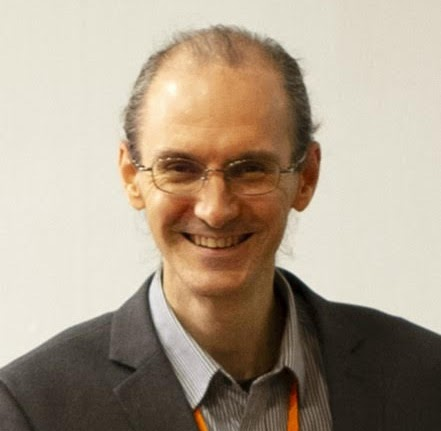
July 27 (Mon) – August 5 (Wed)
Instructor 1 — Dr. Matthew ORSBORN
- Associate Professor, Department of Buddhist Studies, Dharma Drum Institute of Liberal Arts, Taiwan
- PhD, University of Hong Kong (2011)
Matthew Orsborn is an Associate Professor at the Department of Buddhist Studies, Dharma Drum Institute of Liberal Arts, Taiwan. Since completing his doctorate in Buddhist Studies at the University of Hong Kong in 2011, he has taught in Taiwan, Australia, Thailand, and the United Kingdom. His research focuses on Indian Buddhist literature and doctrines, including early, Abhidharma, and Mahāyāna periods, utilizing Pāli, Sanskrit, and Chinese sources. As a former monastic, he has also published on various aspects of contemporary Chinese Buddhism.
For the first half of the program, Matthew will be leading us through selections of Bodhisattva and Mahāyāna literature in classical Chinese translation.
August 5 (Wed) – August 14 (Fri)
Instructor 2 — Dr. Thomas NEWHALL
- Lecturer, Department of Indian Philosophy and Buddhist Studies, University of Tokyo
- PhD, Department of Asian Languages and Cultures, UCLA (2025)
- MA, University of Tokyo (2016)
- MA, Foguang University, Taiwan (2012)
- BA, Oberlin College, Ohio (2007)
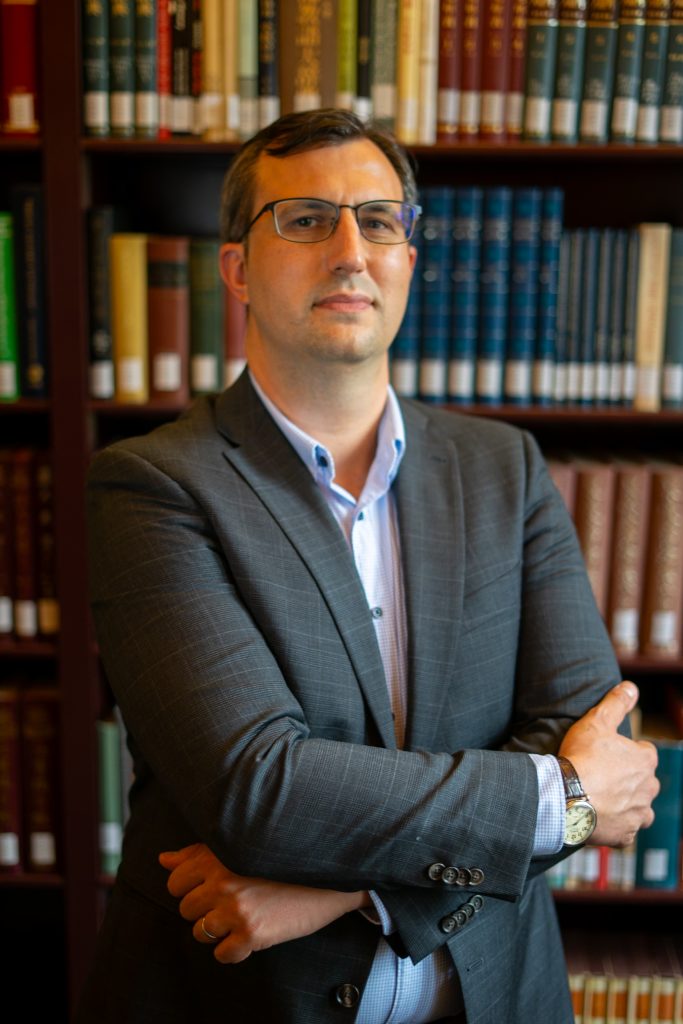
Thomas Newhall is a Lecturer in the Department of Indian Philosophy and Buddhist Studies at the University of Tokyo. He completed his PhD in the Department of Asian Languages and Cultures at UCLA in 2025, and received master’s degrees from the University of Tokyo (2016) and Foguang University (2012) in Taiwan, and a bachelor’s degree from Oberlin College (2007) in Ohio prior to that. His research focuses on the development of monasticism and monastic literature in China and Japan.
During the second half of the program, Tom will guide us through a selection of texts related to the Vinaya and monasticism in East Asia.
Schedule Overview
Course overview
Session I
Dr. Matthew Orsborn
Jul 27–31 · Aug 3–5
Selection of Indian Mahāyāna sūtra literature in Chinese translation
Session II
Dr. Thomas Newhall
Aug 5–7 · Aug 10–14
Selection of Chinese Vinaya literature, including translations from Indian works and Chinese compositions
Typical class day
| 06:00 – 06:40 | Morning service (optional) |
| 07:00 – 08:00 | Breakfast |
| 09:00 – 12:00 | Morning session — Reading & discussion |
| 12:00 – 12:40 | Lunch |
| 13:30 – 16:30 | Afternoon session — Group work |
| 17:00 – 17:30 | Dinner |
| 18:00 – 22:00 | Evening — free time |
Applies to weekdays (Mon–Fri). Aug 1 and Aug 8 are scheduled as supplementary program days.
Key dates
| Fri–Sat, Jul 24–25 | Early check-in available |
| Sun, Jul 26 | Check-in · Campus tour · Course orientation |
| Mon, Jul 27 | Opening of workshop |
| Jul 27–31, Aug 3–7, 10–14 | Workshop sessions |
| Fri, Aug 14 | Closing session of workshop |
| Sat–Sun, Aug 15–16 | Check-out · Farewell |
Supplementary program
The following activities are included in the program. Participation is encouraged but not required.
Sat, Aug 1
Tea-Chan Experience
[PLACEHOLDER: brief description, or delete this line]
Sat, Aug 8
City Cultural Tour
[PLACEHOLDER: brief description, or delete this line]
Pre-Arrival Guide
Welcome to DILA. Our campus sits on Dharma Drum Mountain in Jinshan, New Taipei City — a quiet hillside setting by the sea.
In This Guide本指南內容
This guide covers what you need to know before and after you arrive at DILA — what to bring, on-the-ground logistics at the airport, the check-in process, life on campus (housing, meals, daily basics), and emergency contacts. Tap any section to jump.
Before You Leave
出發前準備Essential Documents必備文件
- Passport & return e-ticket
- Visa support documents — invitation letter, acceptance notice, etc.
- Personal medication
Mobile Data台灣 SIM 卡 / eSIM
Purchase a Taiwan eSIM online before departure, or buy a physical SIM at the airport — see At the Airport.
What to Pack建議自備物品
At the Airport
在機場Prepaid SIM Card購買 SIM 卡
Telecom counters in the arrival hall — Chunghwa (中華電信), FarEasTone (遠傳), Taiwan Mobile (台灣大哥大). Unlimited 4G/5G plans, passport required.
EasyCard悠遊卡
NT$100 per card, top up separately. Valid on MRT, buses, and most convenience stores. Suggest loading NT$500 initially.
Arrival & Check-in
抵校報到OIA provides one-on-one support from arrival to room. Connect with us early — the first few hours are the most challenging part of the journey.
Accommodation — Chanyue Hall
住宿 — 禪悅書苑| Address 地址 | 680 Fagushan Road, Jinshan, New Taipei 新北市金山區法鼓路680號 |
| Room type 房型 | Twin or triple room, shared bathroom 雙人或三人房,共用衛浴 |
| Wi-Fi | Free, campus-wide 免費,全校區覆蓋 |
| Air conditioning 冷氣 | In-room A/C 房間內附冷氣 |
| Cost 費用 | Included — no charge 住宿與課程費用由計畫提供,學員免費 |
Hot Water Hours熱水供應時間
Electricity電費
50 kWh per room per month included. Additional usage: NT$3.5/kWh. Turning off the A/C when you leave goes a long way.
Laundry洗衣
House Rules住宿須知
Meals — Xin-An Xuan Cafeteria
用餐 — 心安軒| Time | Format | Price | |
|---|---|---|---|
| Breakfast 早餐 | 07:30–08:30 | Meal box 便當 | NT$100 |
| Lunch 午餐 | 12:00–13:00 | Meal box 便當 | NT$100 |
| Dinner 晚餐 | 17:00–18:00 | Meal box 便當 | NT$100 |
Vegetarian Menu關於素食
DILA is a lacto-ovo vegetarian campus. Each meal includes a fully vegan option. Please notify us of any dietary needs or allergies in advance.
Daily Life
日常生活On-Campus: Chanyue Vending Area (24/7)校內:禪悅軒
- Vending machines — snacks, drinks, microwave meals (coins required)
- Tatung (大同) electric steamer — for reheating food
- IH induction cooktop — for making instant ramen, etc. 鍋具須為電磁爐適用材質(不鏽鋼或鑄鐵)
Library圖書館
Workshop participants may borrow books using their name tag (名牌). Subject to library regulations.
DILA Library / 法鼓文理學院圖書館Jinshan Town金山鎮上採買
| PX Mart 全聯福利社 | Groceries, produce, household goods |
| Watsons 屈臣氏 | Skincare, medication, personal care |
| 7-ELEVEN / FamilyMart 7-ELEVEN / 全家 | Snacks, parcels, bill payment, ATM |
- On foot — ~40 min downhill
- Bus — Kuo-Kuang (國光客運) toward Jinshan
- Taxi from Jinbaoli Presbyterian Church (金包里教會) — ~NT$200 weekdays / ~NT$250 weekends Tel: 02-2498-2721
Weather — Summer天氣(夏季)
6–8月
Emergency Contacts
緊急聯絡Office of International Affairs (OIA)國際事務組
| +886 966 709 309 |
Campus Security (24 hours)校園安全(24 小時)
| Security 保全室 | +886-963-119-276 |
| Campus ext. 校內分機 | ext. 5099 |
Medical Care就醫資訊
For any emergency or illness, contact Security or OIA first — we will arrange medical assistance.
Nearby Medical Facilities / 校園周邊醫療院所Emergency Numbers緊急電話
| Jinshan Police 金山分局 | +886-2-2498-2009 |
| Police 警察 | 110 |
| Ambulance / Fire 救護消防 | 119 |
How to Get to DILA
DILA sits on Dharma Drum Mountain in Jinshan, New Taipei City — about 1.5 hours by taxi from Taoyuan International Airport (TPE). Below are the recommended routes.
Campus Location
校區位置| Address 地址 | No. 700, Fagushan Road, Jinshan District, New Taipei City 208303208303 新北市金山區法鼓路700號 |
| Main line 總機 | +886-2-2498-0707 |
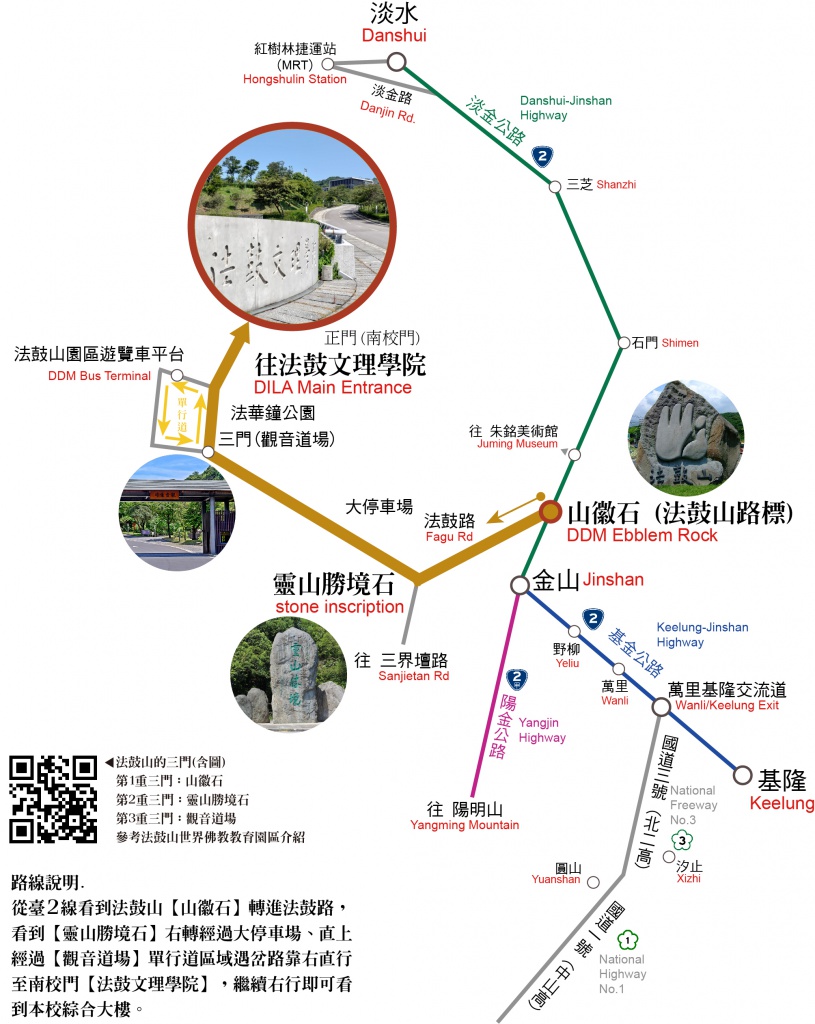
Routes to Campus
抵校路線Option 1Taxi from Airport計程車(最方便)
Option 2Kuo-Kuang Bus國光客運
Option 3Taxi from Jinshan Town從金山鎮搭計程車
By Car & Full Route Info自行開車 & 完整交通資訊
DILA Transportation Guide / 文理學院交通資訊(含動態班次)2026 CBCL Summer Workshop · Life at DILA
During CBC, you will take part in 出坡 chūpō (going out to work) and 普請 pǔqǐng (universal participation): everyone cares for the shared space together, no exceptions. This page gives you a sense of what each day might look like.
“Aren’t you already practising? Isn’t eating practice? Isn’t sleeping practice, walking practice, working practice?” Once you leave home, you come to see that everything you do is practice.
— Master Sheng Yen, Life in a Chan MonasteryThe DILA campus sits in the mountains above Jinshan. Before the morning session begins, the trails are quiet. Some participants use this time for a slow walk; others find a spot near the bridge for informal sitting before class.
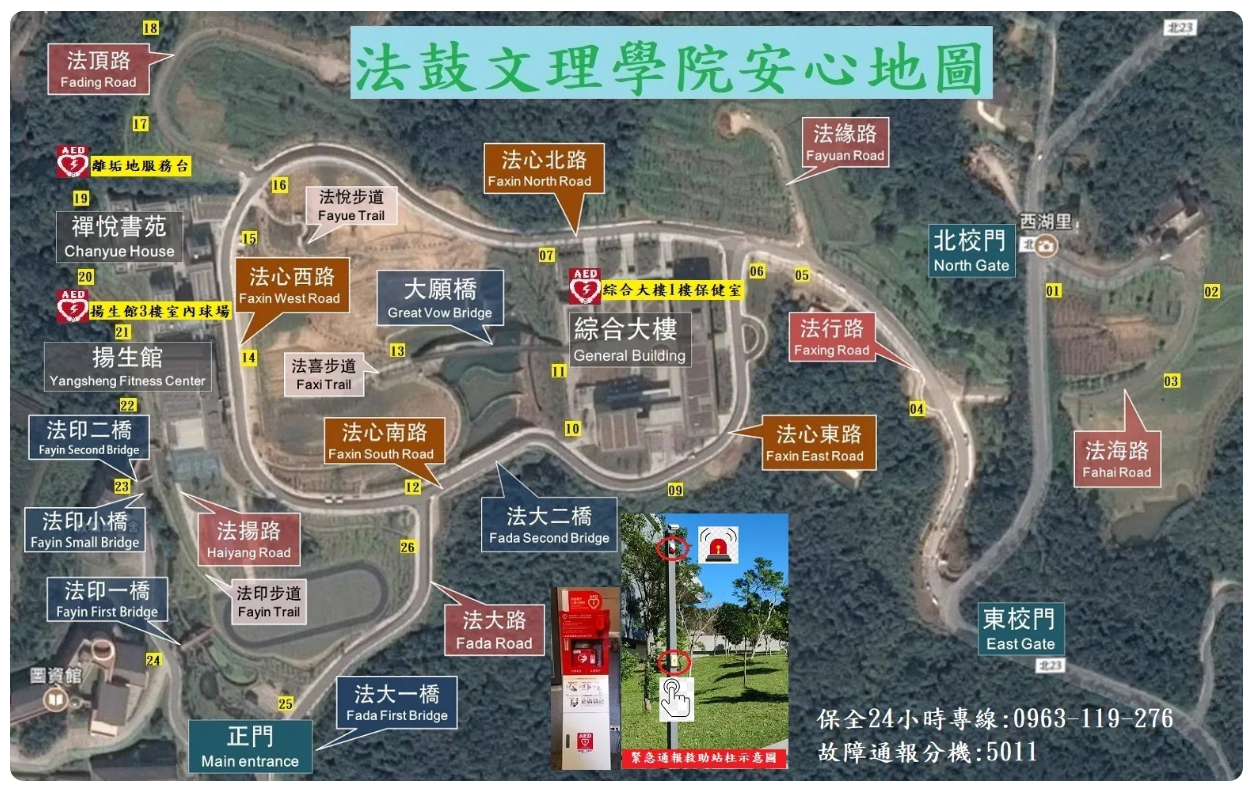
- 法悅步道 Fayue Trail Gentle loop near the main buildings — good for a 15-minute circuit before breakfast
- 法喜步道 Faxi Trail Winds uphill into forest shade; cooler and quieter than the main path
- 大願橋 Great Vow Bridge Shaded and still; a natural spot for quiet sitting before the day begins
- 揚生館 Yangsheng Fitness Center Open during designated hours — ask at the office for the current schedule
Move slowly. Notice the surface under the cloth. Return things to order — this is the work. During CBC, participants share responsibility for dormitory and classroom spaces, rotating every 1–2 weeks.
- Each area: clean at least once per week
- Bins: empty when full — don’t wait for cleaning day
- Whiteboard: wipe at the end of every class session
- Trash & recycling: outside the laundry room, 1F of the dormitory building
Contact Info
Two channels for reaching the Office of International Affairs (OIA) before and during the workshop. Use whichever fits — but every message must follow the format below.

- Your registered full name
- “CBC 2026”
- A brief reason for contacting us
Messages without these three details may not receive a response. OIA handles many inquiries during the workshop period — this format ensures yours reaches the right person quickly.
For on-site campus security and medical emergencies, see Pre-Arrival Guide → Emergency Contacts.
🔴 [CLOSED] Applications closed on April 30, 2026.
Application Link: https://forms.gle/caEb1b7VKtc7EXPS7
Eligibility: Currently enrolled graduate students with a solid foundation in classical Chinese and Buddhist studies.
Housing: DILA offers housing subsidies at Chanyue (禪悅) for all accepted participants.
Capacity: Limited to 20 participants (on-campus housing provided)
Expenses: Participants are responsible for their own airfare, insurance, and meal expenses.